Problem
A recipe is written for a supermarket run, not for a kitchen. The standard instruction assumes you have an oven, a stand mixer, a lemon and precisely twelve grams of something, so the moment you open the fridge the recipe is already wrong.
That is the normal case. Most people cook from a partial shop and a fixed set of equipment, and the useful question is not "what should I cook" but "what can I cook with what I have, using the two things my kitchen actually contains".
Process
The recipe data was collected by scraping rather than written by hand, because hand-writing a usable corpus takes longer than the rest of the project combined, and the interesting problem was not the corpus.
The interesting problem is the constraint. A generated recipe is worthless if it sends you to the shop, so every step has to be checked against what the user actually has available before it is returned. If the answer cannot be made to work with that pantry and that equipment, the constraint has to hold and the dish gets changed, not the ingredient list.
Input is the rear camera, live. The device camera is opened through
getUserMedia and frames are sent straight to a vision model, so the pantry
gets read rather than typed. Typed input is the fallback for when someone is
holding three ingredients and cannot get the phone out.
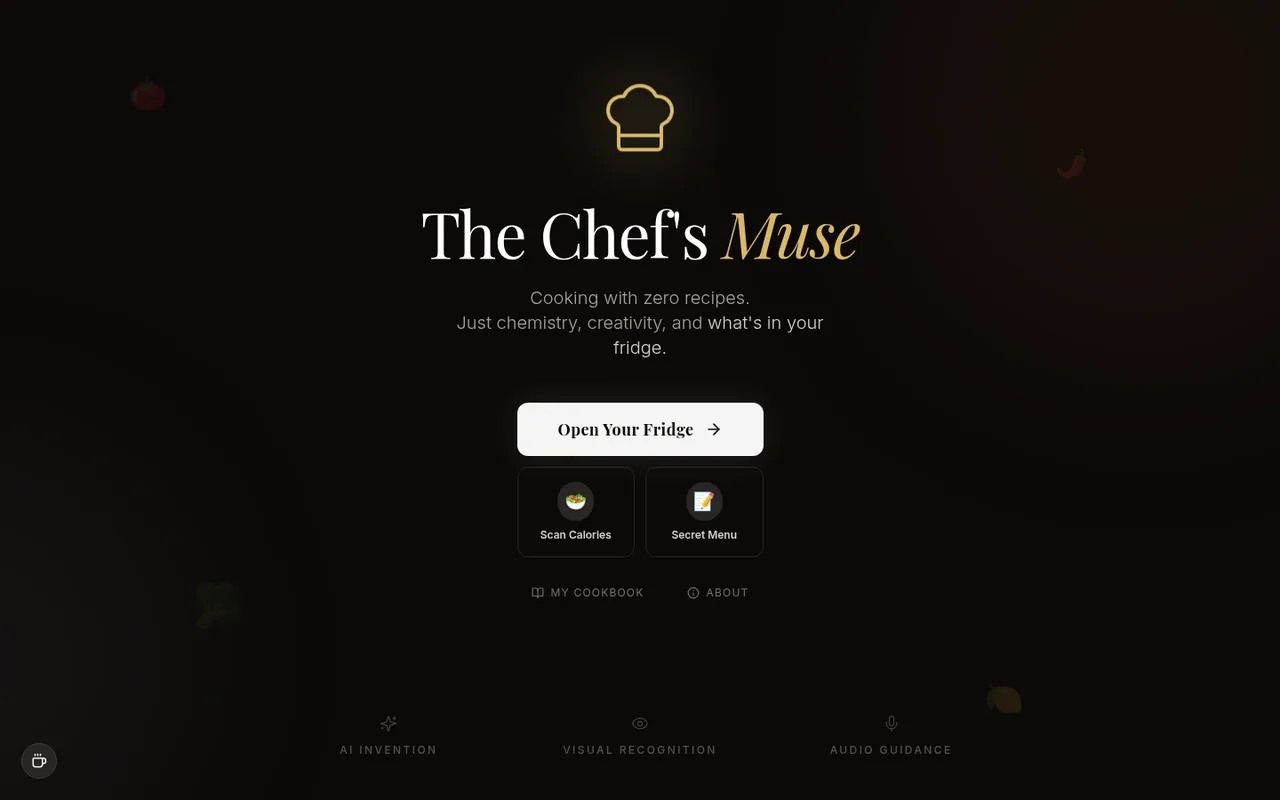
Output covers the three ways someone actually reads a recipe. The dish gets a generated photograph, prompted as professional food photography from the dish name and its first ingredient. The steps get read aloud through Gemini's speech model, because half the time you are holding a pan you cannot put down. The written steps stay the source of truth, since audio is not something you skim.
Gemini does the reading and the writing. gemini-flash-latest takes the camera
frames and returns a recipe as structured JSON against a fixed schema, so the
front end parses one known shape instead of scraping prose out of a paragraph.
TypeScript throughout, deployed to GitHub Pages.
Result
Live on GitHub Pages with the source public. Camera to pantry to constrained recipe in one flow, with a spoken read-through at the end.